
The gap between knowing AI exists and knowing what to do with it on a Tuesday morning is wider than most organizations expect, and more consequential than most leaders admit.
Most teams today sit somewhere in that gap. They have seen the headlines, attended the webinars, even run a pilot or two. Tools have been procured. Subscriptions activated. Yet when the workday begins in earnest, the question remains: where does AI actually belong in this workflow, and where does it quietly create more confusion than value?
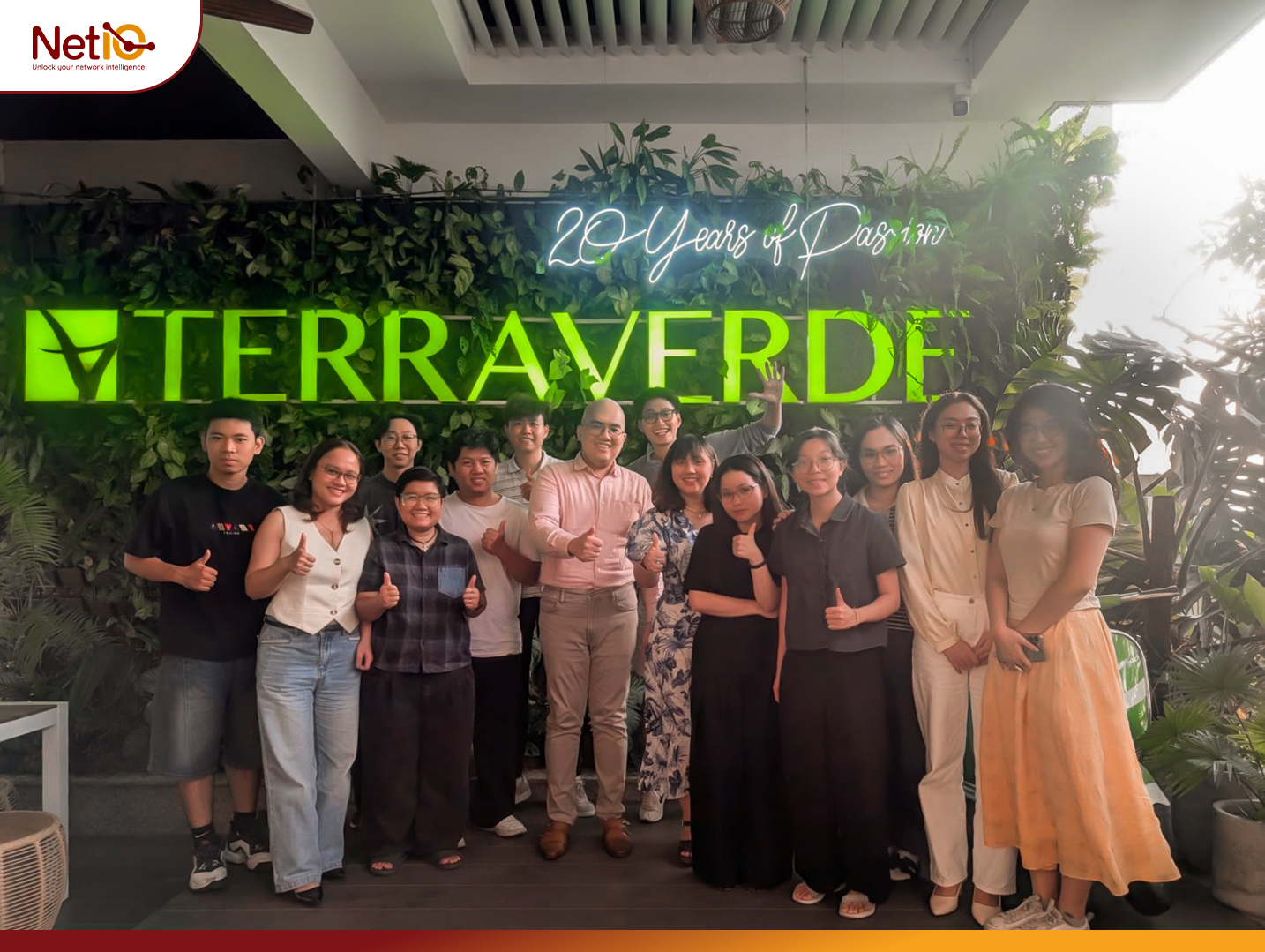
This is the question NetIQ was invited to explore with Terraverde Travel & Events (one of Vietnam’s leading travel brands) in April 2025. What began as an AI training engagement became something more instructive: a close look at what it actually takes to move a team from curiosity to lasting capability.
The gap most training programs share
The breakdown in AI training follows a predictable pattern. An organization brings in an external facilitator to demonstrate a set of tools. Enthusiasm peaks on the day. Completion rates are logged. Certificates are issued. Within weeks, the majority of participants have returned to their familiar workflows, and the tools sit largely untouched.
The reason is rarely disinterest. It is almost always the absence of a structured mental model.
Without a clear framework for thinking about where AI helps, and where it introduces risk, reduces quality, or simply doesn’t belong, people default to trial and error. Some become over-reliant on outputs they haven’t critically evaluated. Others disengage entirely. Neither outcome builds any new capability. Both reflect a training design that prioritized tool exposure over cognitive scaffolding.
Enthusiasm after a training day is easy to generate. The harder question is what remains six weeks later.
What the Terraverde program was built to do
When NetIQ designed the program for Terraverde, the central question was not which tools the team should adopt. It was more fundamental: how do you give people a durable way of thinking about AI, one that holds up not just during a facilitated session, but on an ordinary Wednesday afternoon two months later?
The program was structured around four frameworks.
It opened with NetIQ’s 5-Layer Taxonomy, a classification system that helps people assess the nature of a task before deciding whether and how AI fits into it. The taxonomy distinguishes between tasks where AI reliably accelerates quality, tasks where it introduces manageable risk, and tasks where human judgment remains non-negotiable. For a team managing client relationships, bespoke itineraries, and high-stakes travel experiences, that distinction is not theoretical. It is a daily operational question.
From there, participants worked through applied prompting using the RCTF Framework: Role, Context, Task, Format. Where most prompting guidance teaches people to write cleaner sentences, the RCTF Framework teaches something more transferable: how to think like an effective collaborator before issuing any instruction at all. The shift it produces is from passive user to active director, and it measurably improves the quality and reliability of AI outputs across very different task types.
The afternoon shifted to workflow design through the DECODE Methodology, which helps teams identify where existing processes can be restructured around AI assistance, rather than simply having AI bolted on after the fact. This distinction matters more than it might appear. Retrofitting AI onto legacy workflows captures a fraction of its potential. Redesigning workflows with AI in mind builds the foundation for compounding productivity gains over time.
The session closed with the Second Brain system, a knowledge management methodology that ensures insights generated during working sessions are captured in structured, reusable form. Without a deliberate capture system, even good thinking evaporates. The Second Brain converts ephemeral discovery into institutional memory the team can build on.
What changed, and what didn’t
By the end of the day, the Terraverde team’s access to AI tools was exactly what it had been that morning.
What changed was their relationship with those tools. Participants who had arrived feeling overwhelmed by the volume of options and uncertain about where to begin left with a clear, repeatable sequence: classify the task, establish the context, build the prompt, map the workflow, capture the output. Each step is learnable. Together, they form a system that works on a Monday morning and remains intact on a Friday afternoon.
That is the meaningful distinction between AI training that produces enthusiasm and AI training that produces capability. Enthusiasm fades. Capability compounds.
The underlying principle
The Terraverde engagement reflects a pattern NetIQ observes consistently across organizations of different sizes and industries: the limiting factor in AI adoption is almost never access to technology. The tools are available. The barrier is the mental model that determines how, and whether, people engage with them in real work.
Getting that model right, before the tools, before the workflows, before any metric is tracked, is where meaningful AI adoption actually begins.
NetIQ is a Vietnamese consultancy specializing in AI adoption and organizational transformation. Our work is grounded in network science and a synthesis of real-world case studies.