
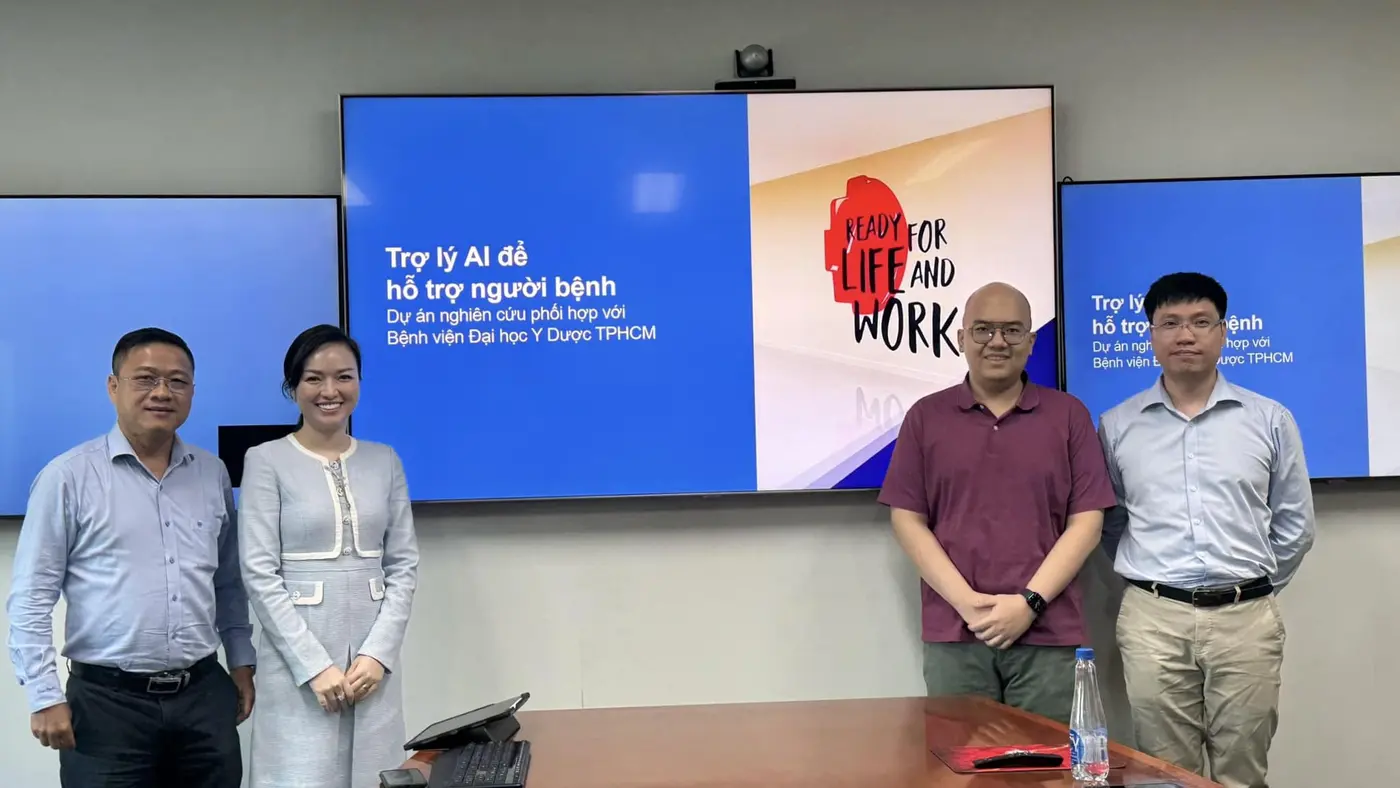
Executive Context
Healthcare organizations face growing pressure to improve service quality while managing rising operational complexity and resource constraints.
Hospital leadership sought to leverage AI to:
- Reduce administrative burden on frontline staff
- Improve patient access to information and services
- Maintain clinical safety, data privacy, and trust
Executives needed clarity on how AI could be applied responsibly in a high-risk, regulated environment without disrupting clinical workflows.
Leadership Role & Contribution
Dr. Duy served as the lead advisor and solution architect, guiding the initiative from concept to implementation. His role focused on:
- Defining the strategic objectives of AI adoption in a healthcare setting
- Translating clinical and operational requirements into AI system design
- Ensuring alignment between technology, data governance, and organizational readiness
The approach prioritized usability, safety, and accountability, rather than experimental or technology-driven deployment.
Key Deliverables
- Design of an AI-powered healthcare chatbot to support patient inquiries and internal processes
- Clear definition of use cases appropriate for automation versus human intervention
- Governance considerations for data usage, privacy, and system oversight
- Integration guidance to ensure minimal disruption to existing healthcare operations
Business Outcomes
- Improved efficiency in handling routine patient and operational inquiries
- Reduced workload for administrative and support staff
- Enhanced patient experience through faster and more consistent access to information
- A practical foundation for scaling AI solutions within a healthcare environment
This project demonstrates how AI can be applied in healthcare as a controlled, value-driven capability, not a high-risk experiment. Dr. Duy’s approach enables executive teams to adopt AI with confidence—balancing innovation with patient safety, regulatory responsibility, and organizational trust.